

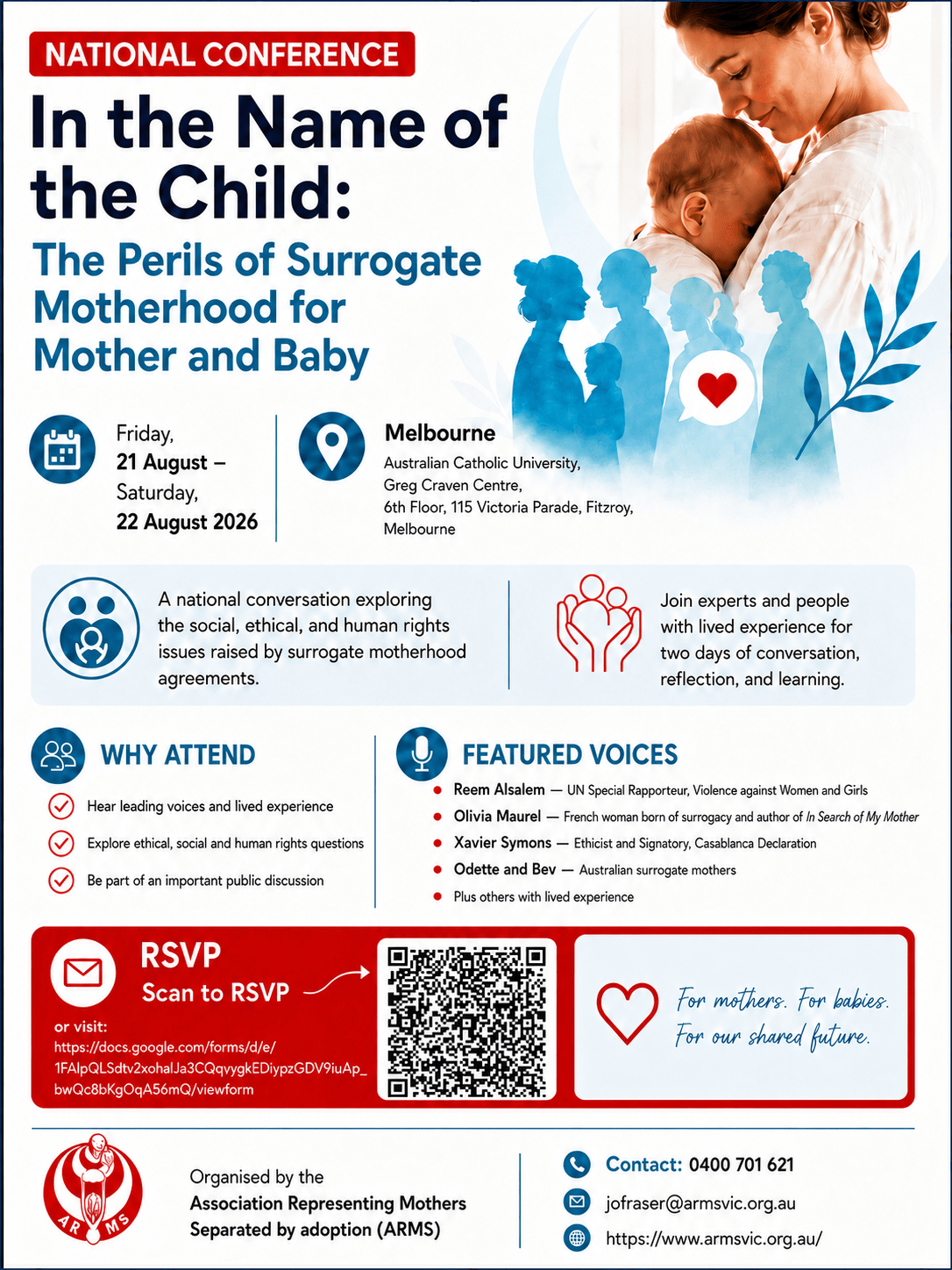
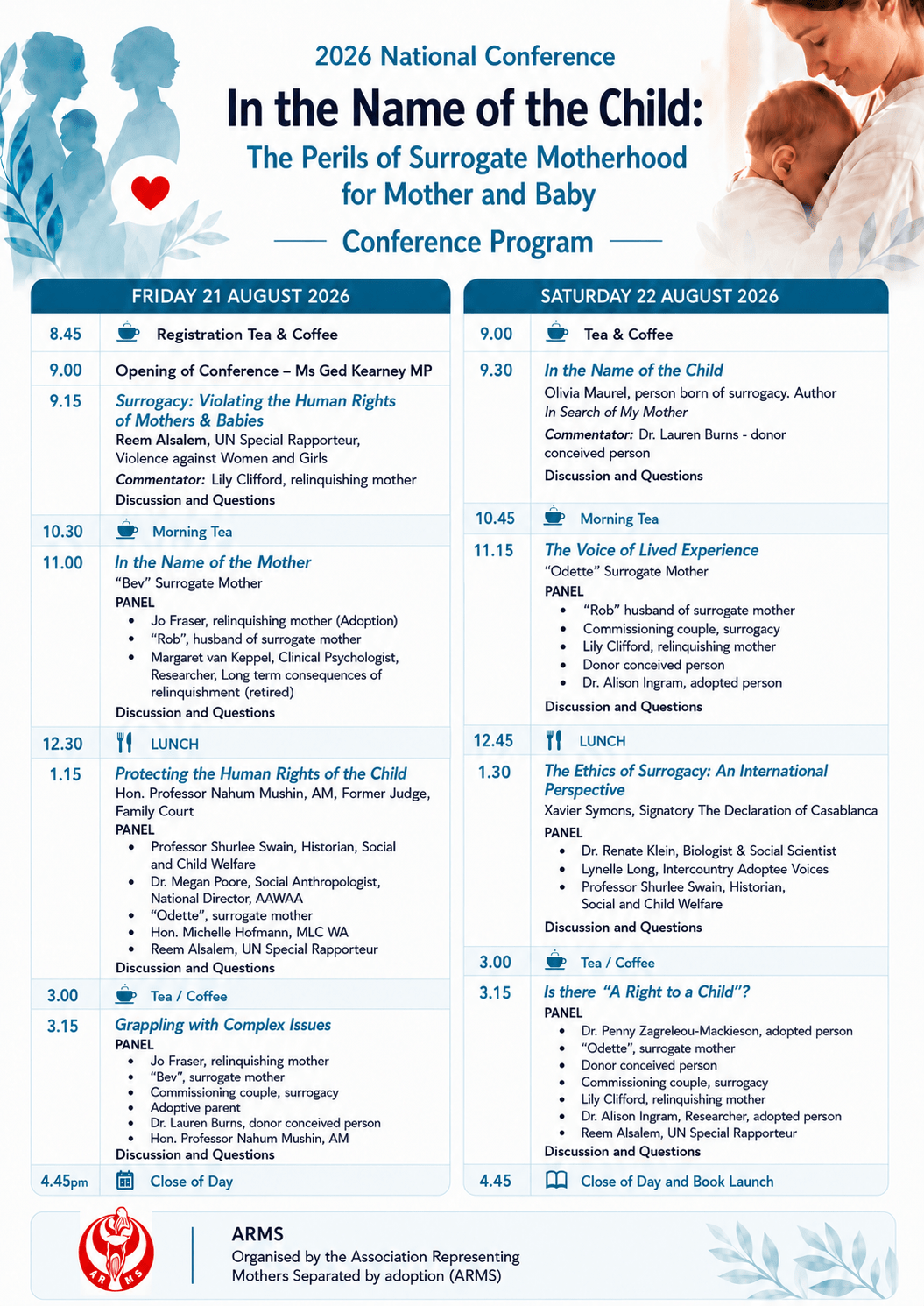
Presented by Lynelle Long on Saturday 22 August 2026
Speaker 3 in the panel: The Ethics of Surrogacy – An International Perspective
Hello all and a huge thank you to Jo and Lily from ARMS for inviting me to be a part of your conference today!
When we discuss surrogacy, the conversation usually begins with adults. We talk about intended parents’ desire for a family, reproductive freedom, the autonomy of the woman carrying the pregnancy, contracts, payments, clinics, donors and legal parentage. All of these matter but the person most often missing is the person being deliberately created.
I come to this discussion as a Vietnamese-born intercountry adoptee and founder of InterCountry Adoptee Voices. For almost three decades, I have listened to adoptees describe the lifelong consequences of decisions made about us when we had no voice. I too have lived these impacts and to this day, I still do not know my origins nor do I have access to basic rights that should have been mine such as citizenship in my own country of birth.
Intercountry adoption and surrogacy are not the same. I do not want to collapse the experiences of adoptees, surrogate-born people, donor-conceived people or women who carry pregnancies for others but there are important parallels in our journeys. In both systems, adults make decisions before the child can speak. Money, agencies, lawyers and cross-border arrangements may be involved. Legal documents decide who will be recognised as family. The child may grow up separated from people fundamental to their identity and the process is often declared successful once the child is transferred to the intended family. Those of us who grow up inside these arrangements must then live with the consequences for our lifetime and into the next generation. I have children – they too are impacted by my lack of knowledge of myself and rights.
Intercountry adoption has taught me a crucial lesson: A process can satisfy the adults involved and still fail the child.
A recent Canadian case that’s been in the media illustrates this danger. An Ontario woman was carrying a child for two intended parents. At approximately 22 weeks, prenatal testing suggested a cleft lip, possible cleft palate, a minor heart condition and possible genetic concerns. The intended parents reportedly invoked a contractual provision asking for the pregnancy to be terminated. The woman refused and sought further testing. Later assessments reportedly found the child otherwise healthy, and the pregnancy continued. The child was born, but the dispute has developed into a civil claim reportedly worth approximately 600,000 Canadian dollars. The allegations remain before the court, so we should not presume who will legally succeed.
But ethically, where was the future child in that contract?
Was the child’s acceptance conditional upon health, appearance or disability status? Who independently considered the interests of the person whose life and future were being negotiated? What might that person feel if they learn that a correctable difference led to an argument about whether their life should continue?
This is not simply a debate about abortion. It is about disability rights, conditional acceptance and what happens when a child is treated as the expected product of a commissioned process.
Another well known case in the media is that of Australian Baby Gammy which shows what can happen after birth. Gammy and Pipah were twins born in Thailand in 2013 through a commercial surrogacy arrangement involving an Australian couple. Gammy has Down syndrome. Pipah was taken to Western Australia, while Gammy remained in Thailand with the woman who gave birth to them. The Family Court later found that the Australian couple had wanted both children and had not deliberately abandoned Gammy because of his disability. That factual correction matters but it does not make the outcome ethical.
Twins who shared a pregnancy and birth were separated between different families, countries, languages and cultures. The judge called their separation an “appalling outcome.” Pipah’s genetic father had previously been convicted of child sexual offences. By the time the court decided the case, Pipah was attached to the only household and family she remembers. The court concluded that removing her could itself cause significant harm and allowed her to remain under protective arrangements, including independent representation, a safety plan and ongoing child-protection monitoring.
The court was left choosing the least damaging option after the adults and the surrogacy system had already created the crisis. That is the ethical failure.
Best interests considered at the end cannot repair the failure to protect rights at the beginning.
How could someone with convictions for sexual offences against children commission the birth of a daughter without an independent child-safety assessment before conception? How was separating twins across international borders consistent with their right to family relationships? Who was responsible for ensuring Gammy and Pipah could know each other and understand their shared history? Who considered the lifelong psychological consequences of separating twins and allowing them to grow up in entirely different families and countries?
This is where the journey of surrogate-born people begins to echo the journey of many intercountry adoptees.
In 2025, I created an Intercountry Adoptee Rights Charter because adoptees are still fighting for rights that should never have been taken from us. The Charter is based not only on what should happen during childhood, but on what we adoptees have said we need throughout an entire lifetime. But we’ve only been able to verbalise this as mature aged products of the system.
Many of these same principles are directly relevant to people born through surrogacy.
The right to identity
For intercountry adoptees, this means knowing our original name, nationality, ethnicity, culture, language and biological family. For a surrogate-born person, identity may include the egg donor, sperm donor, gestational mother, genetic siblings, the circumstances of conception and the cultures or countries connected to each of them. A legal birth certificate naming the intended parents may establish legal parentage but it does not necessarily preserve the whole truth of a person’s identity.
As adoptees, we know how destabilising it can be when the official version of our identity does not match our biological, cultural or lived reality. Surrogate-born people should not have to fight as adults to reconstruct information that was deliberately separated, anonymised or hidden when they were born.
The right to information
Intercountry adoptees often discover that our records are sealed, redacted, incomplete, falsified or scattered across agencies and countries. We may not know why separation occurred, whether our parents gave free and informed consent or how much money changed hands. Surrogate-born people may face similar fragmentation.
Medical information may sit with a fertility clinic. Donor information may be protected by anonymity. Gestational history may remain with the woman who carried them. Contracts and payment records may remain private. Genetic siblings may be unknown or spread across several families and countries. Every person should have the right to complete, accurate and permanently preserved information about how they came into the world. That must include financial transparency where money shaped the arrangement.
In my Adoptee Rights Charter, I specifically include the right to know whether money was exchanged, how much was paid and what ethical standards were applied. This is equally important in surrogacy. We cannot properly assess consent, exploitation or conflicts of interest when financial arrangements remain confidential while the person created through them is denied access.
The right to contact and family relationships
Intercountry adoptees may spend decades searching for parents, siblings and relatives whom the law treated as though they no longer existed. Some discover that their families had not forgotten them. Some find siblings who were raised together while they alone were sent overseas. Others are unable to reconnect because names were changed, documents were falsified or information was deliberately withheld. Surrogate-born people may also have meaningful genetic, gestational and sibling relationships that cannot be reduced to the single legal category of “parent”. Gammy and Pipah show why this matters. Their wellbeing cannot be measured only by saying that each child was thriving in a separate household.
Thriving does not erase the loss of a twin relationship.
Children should not have to prove psychological damage before their sibling bond is treated as worthy of protection. A rights-based system would have required an enforceable plan to protect their relationship across borders, including contact, shared information, travel and ongoing support. Instead, the children were left to carry the consequences of decisions and disputes between adults.
The right to truth and transparency
Intercountry adoptees have often been told simplified stories: that we were unwanted, abandoned, orphaned or rescued. Later, some discover coercion, poverty, falsified documents, improper financial gain or families who were still searching for them. People born through surrogacy also have the right to age-appropriate truth from childhood.
They should not discover through DNA testing, a medical crisis or an accidental disclosure that information about their conception was withheld. They should know whose genetic material was used, who carried and gave birth to them, whether other embryos or siblings exist and what arrangements were made between the adults. Nor should their conception and birth be used as promotional material by intended parents, clinics or agencies without their future dignity and privacy being considered. Their story belongs first to the person who must live it.
The right to legal and human protection
Some intercountry adoptees have experienced citizenship failures, deportation, informal rehoming, abandonment or an inability to challenge an adoption created without our consent. Some have discovered that the adults and agencies involved completed a placement but failed to secure the child’s permanent legal status. International surrogacy can also leave children with uncertain parentage, nationality or immigration status when countries apply conflicting laws.
A disagreement between adults must never leave a child legally parentless, stateless, stranded or without someone unconditionally responsible for their care. A child should not lose protection because a surrogacy arrangement was unlawful. They should not be punished because adults crossed borders to avoid restrictions in their own country. Nor should intended parents be able to withdraw their responsibility because a relationship ends, a genetic connection is disproved, the child has a disability or the arrangement no longer suits them.
Responsibility must be determined and legally guaranteed before conception, with contingency plans for separation, death, disability, multiple births or a decision by the intended parents not to proceed.
The right to safety
My Adoptee Rights Charter includes the right to grow up free from abuse, neglect and exploitation, with independent oversight and legal recourse when mistreatment occurs. The Baby Gammy case demonstrates why safety cannot begin only after the child is living with the intended parents.
Intended parents should undergo independent criminal-history, child-protection and family-violence checks and education before a pregnancy begins. Those assessments must not be conducted by a clinic, agency or lawyer who will benefit financially if the arrangement proceeds. The assessment must be independent, child-centred and at least as rigorous as the assessment required for adoption or foster care.
It is extraordinary that some adults can be considered unsuitable to adopt or foster a child, yet can travel overseas and commission the conception and birth of one.
The right to disability protection
My Charter also includes a separate section protecting adoptees with disabilities and complex medical needs.
It recognises that disability must not be used as a justification for separating children from their families, exporting them to another country or abandoning them after placement. It also requires families to be properly assessed, trained and supported to provide lifelong care. These principles must apply to surrogacy.
A child should never discover that their welcome depended upon meeting the health, sex, appearance or genetic expectations of the adults who commissioned their birth. Intended parents must be assessed on their willingness and capacity to care for the child who is born—not merely the child they imagined.
Disability must never reduce a child’s entitlement to care, family, nationality or relationships with siblings. And no payment should be conditional upon the child being born without disability or satisfying contractual expectations.
The right to lifelong emotional support, autonomy and self-determination
Adoptees are frequently told that love should be enough and that gratitude should silence difficult feelings. Yet we may carry grief, identity confusion, racial isolation and the effects of separation throughout life. We do not yet know enough about how surrogate-born people will experience identity, secrecy, donor connections, sibling loss or the knowledge that money and contracts surrounded their conception. We should not wait until a generation of adults tells us what was missing.
Lifelong, independent, identity-informed counselling and peer support should be built into the system. Surrogate-born people must also be free to define their own families and identities. They must be free to seek or refuse contact. They may deeply love their intended parents while also wanting connection with the woman who carried and gave birth to them. They may appreciate their life while still objecting to the practices that surrounded their conception. They may question surrogacy without being accused of rejecting their family or being ungrateful for their existence.
Love and rights are not opposites. Gratitude must never be the price of belonging.
People born through surrogacy already possess human rights, but there is no binding international convention specifically regulating surrogacy and protecting those rights consistently across borders.
The non-binding Verona Principles provide an important foundation by treating the child born through surrogacy as an independent rights-holder. They call for urgent attention to identity, origins, nationality, parentage, non-discrimination and protection from sale and exploitation. Yet international regulation remains fragmented.
In March 2026, after years of expert work, the Hague Conference decided not to proceed at this stage to drafting a convention on the recognition of legal parentage arising from international surrogacy arrangements. That is why I believe we need a Surrogacy-Born Persons’ Rights Charter, developed with adults and young people born through surrogacy and donor conception.
It should guarantee:
- identity and access to origins;
- complete and accurate records;
- sibling and family relationships;
- truthful disclosure;
- secure nationality and parentage;
- pre-conception safeguarding;
- disability equality;
- unconditional care;
- independent representation;
- lifelong support;
- and access to justice and reparation when harm occurs.
The ethical question is not simply whether the adults consented nor whether a contract was lawful or whether money changed hands and it is not answered merely by pointing to the birth of a wanted and loved baby.
The real test is whether the person created can grow up with truth, identity, safety, secure family relationships, nationality, unconditional care and a path to justice.
There is no universal human right to obtain a child.
Paying for a process must never give anyone a trump card over a woman’s body, a child’s disability rights or a person’s lifelong identity.
A child must never become the risk allocated by a contract.
If surrogacy is to continue internationally, the person born through it must no longer be treated as the successful outcome of an adult arrangement.
They must be recognised before conception, at birth and throughout their life as its central rights-holder.
Thank you for listening.

Resources
Surrogacy is a new form of human trafficking
Casablanca Declaration for the universal abolition of surrogacy